
 By asahifile
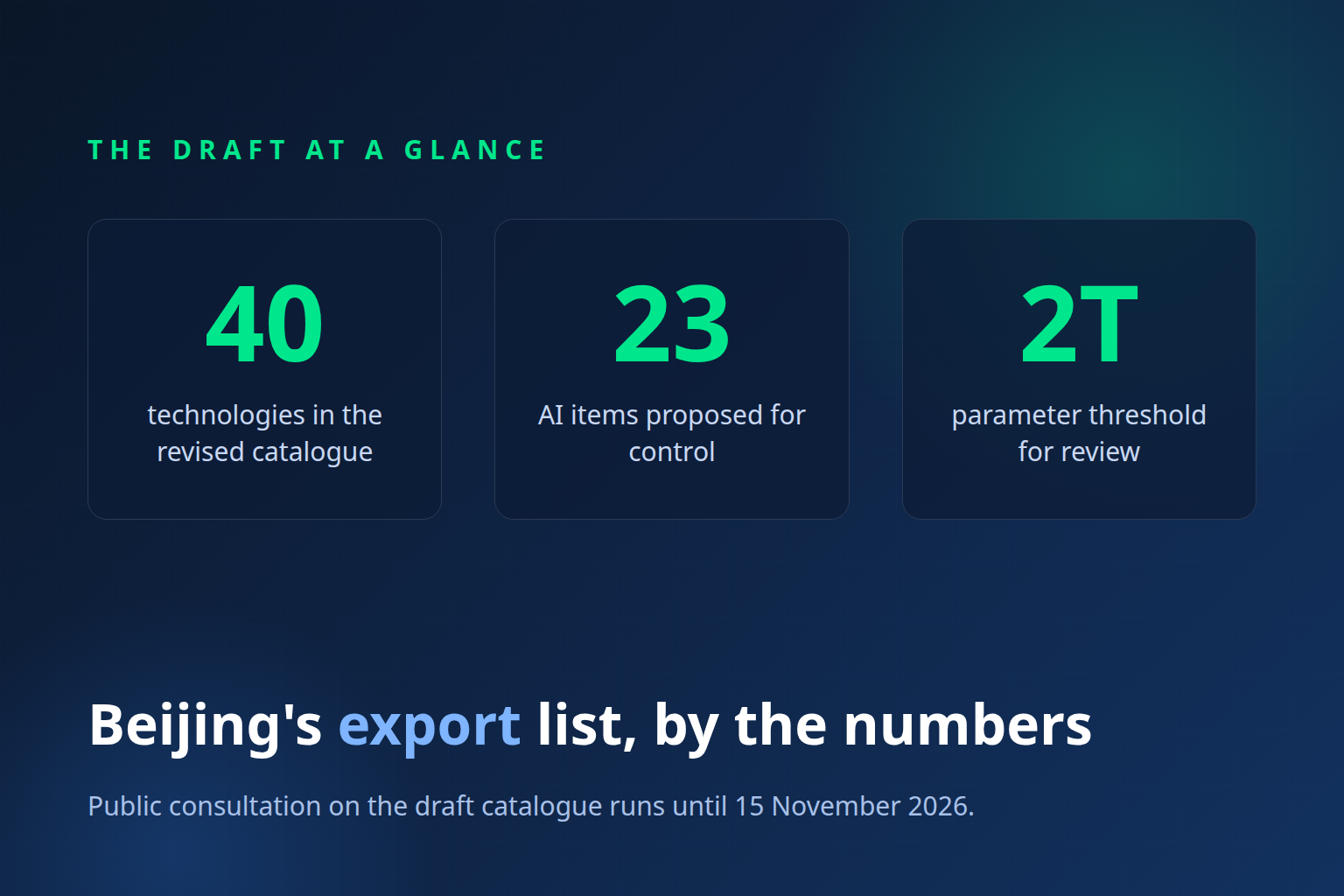
China’s Ministry of Commerce and Ministry of Science and Technology published a draft revision of the country’s export control catalogue on 16 October 2026, proposing to add 40 technologies — 23 of them tied to artificial intelligence — to the list of items that can be restricted or banned from leaving the country. A temporary registration requirement for exports covered by the list took effect the same day. Public consultation runs until 15 November.
What the draft would cover
The AI entries cover “large-scale models, intelligent agents, computing clusters and information processing,” according to the ministries’ announcement. In practice that means four groups of technology: frontier model development, agents built for sensitive environments, chip design know-how, and high-performance computing systems.
On semiconductors, the draft reaches design technologies for AI processing chips at 14 nanometres or below, for 2.5D and 3D stacked chips, and for some memory chip designs. Because these are design and know-how items rather than finished hardware, the rules can catch transfers that never involve a physical shipment — engineering assistance, licensing, overseas research collaboration or a corporate acquisition. Companies hunting for Chinese intellectual property or engineering talent therefore sit inside the scope even when no chip crosses a border.
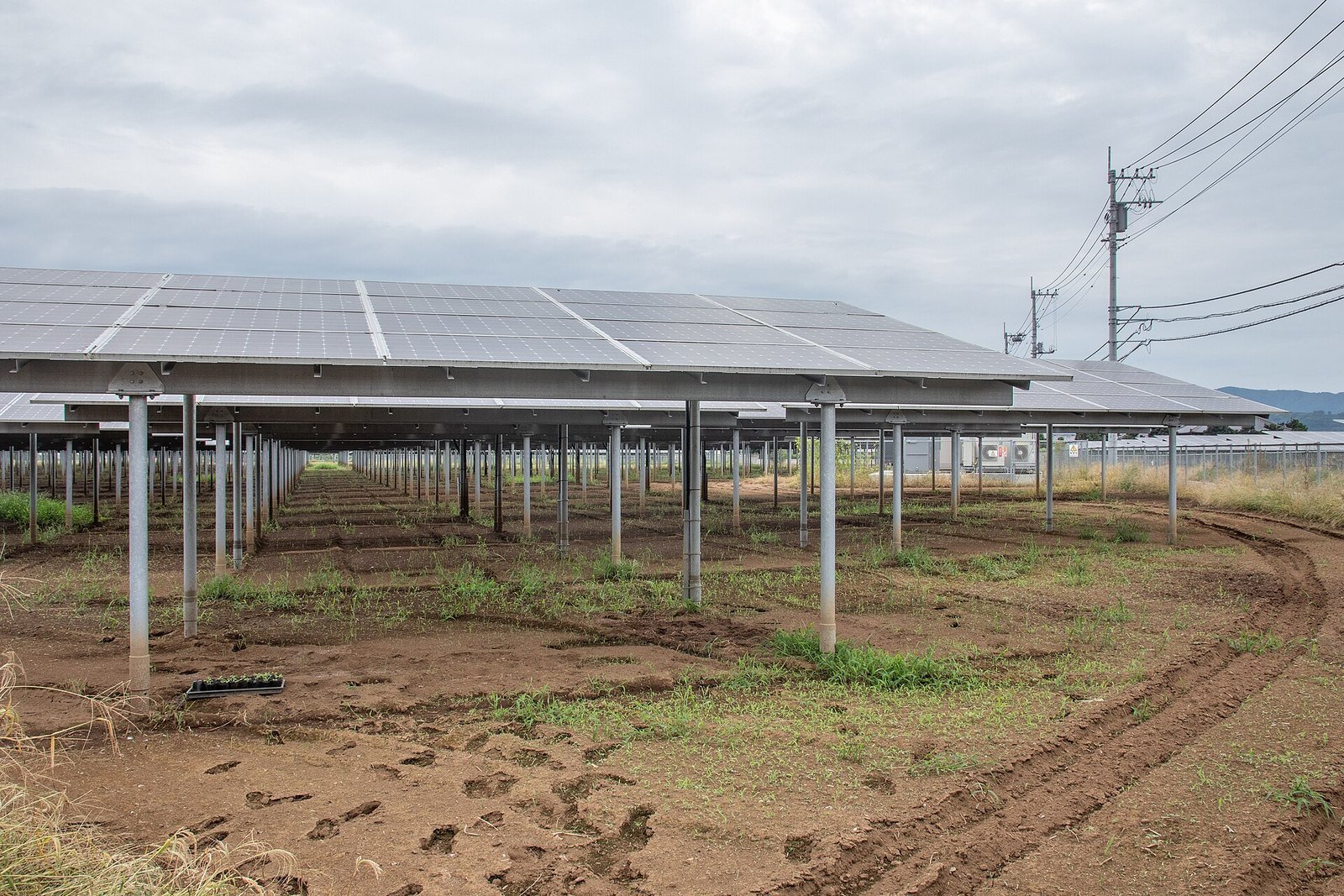
Beyond AI, the catalogue adds 12 photovoltaic technologies covering polysilicon, silicon wafer and cell manufacturing, plus five biomedicine items including cell and gene therapy and siRNA.
Prohibited, restricted, and deliberately exempt
Exports of core technologies of AI large models trained using sensitive national data would be prohibited, along with AI agents designed for highly sensitive environments such as national defence and critical information infrastructure. Restricted items include models with two trillion parameters or more, or those meeting certain world-leading capability thresholds. The draft names no model; reporting by Bloomberg and the Associated Press places Moonshot AI’s Kimi K3 and Alibaba’s Qwen3.8-Max above that size. Restrictions would cover model weights and source code, not only documentation.
The ministry drew two deliberate boundaries. Technology already in the public domain — open-source releases and published academic papers — is out of scope. And access through APIs, websites, apps and software-as-a-service platforms is not treated as a technology transfer. Reuters noted the distinction could let developers such as DeepSeek and Alibaba keep expanding abroad while Beijing retains oversight of the underlying know-how. Running a covered model on servers overseas would still count as an export, though companies deploying on their own overseas cloud could receive licences automatically, and simplified licensing is planned for some joint research and capacity-building work.

Why Beijing is doing this now
The timing mirrors Washington’s playbook. The United States has spent years restricting China’s access to advanced AI chips and the equipment that makes them; Beijing’s draft reads partly as a reply to Western “sovereignty requirements” on AI, robotics and telecommunications, and partly as a recognition that Chinese models have become worth guarding. Since DeepSeek’s R1 emerged, Chinese systems have gained ground abroad on lower prices and improving capability, which raises the strategic value of the technology itself.
There is a security rationale layered on top. The commerce ministry said the measures aim to reinforce the “security bottom line,” prevent misuse and abuse — including systems capable of autonomously generating and modifying malicious software that could threaten critical infrastructure — and ensure AI remains under human control. That framing echoes concerns in both capitals about AI-accelerated cyberattacks, and it lands while the two governments are building a dialogue and an incident-notification channel for advanced AI.
The design is narrower than the headline number suggests. The ministry said the vast majority of AI technologies would remain freely exportable. But the temporary registration requirement is the more immediate commercial fact: it is in force now, before the consultation closes, and it covers deals that are not yet complete.
What to watch
- Whether the final catalogue, expected after 15 November, keeps the two-trillion-parameter threshold or swaps it for capability-based tests that are harder to measure and easier to widen.
- How the registration requirement is enforced in practice — whether filings become routine paperwork or a de facto licence queue for overseas model deployments.
- Whether the open-source and published-research exemption survives industry lobbying, since it is the clearest carve-out for Chinese developers competing globally.
- Whether other governments answer with reciprocal controls on technology transfers to and from China, turning the catalogue into another front in the wider export-control contest.
Sources: Reuters via WHBL, The Next Web, Fortune / Associated Press, International Business Times, The American Quorum