
 By asahifile
Tesla’s long-delayed next-generation Roadster finally made its public return on October 15, 2026, at a SpaceX test site near McGregor, Texas — nearly nine years after the company first showed the car in 2017. The demonstration was unlike any vehicle reveal in recent memory: the white two-seater drove up an inverted ramp using a suction fan system, hung upside down, spun itself around in mid-air, and eased back to the pavement on cold-gas thrusters built in collaboration with Elon Musk’s rocket company SpaceX.
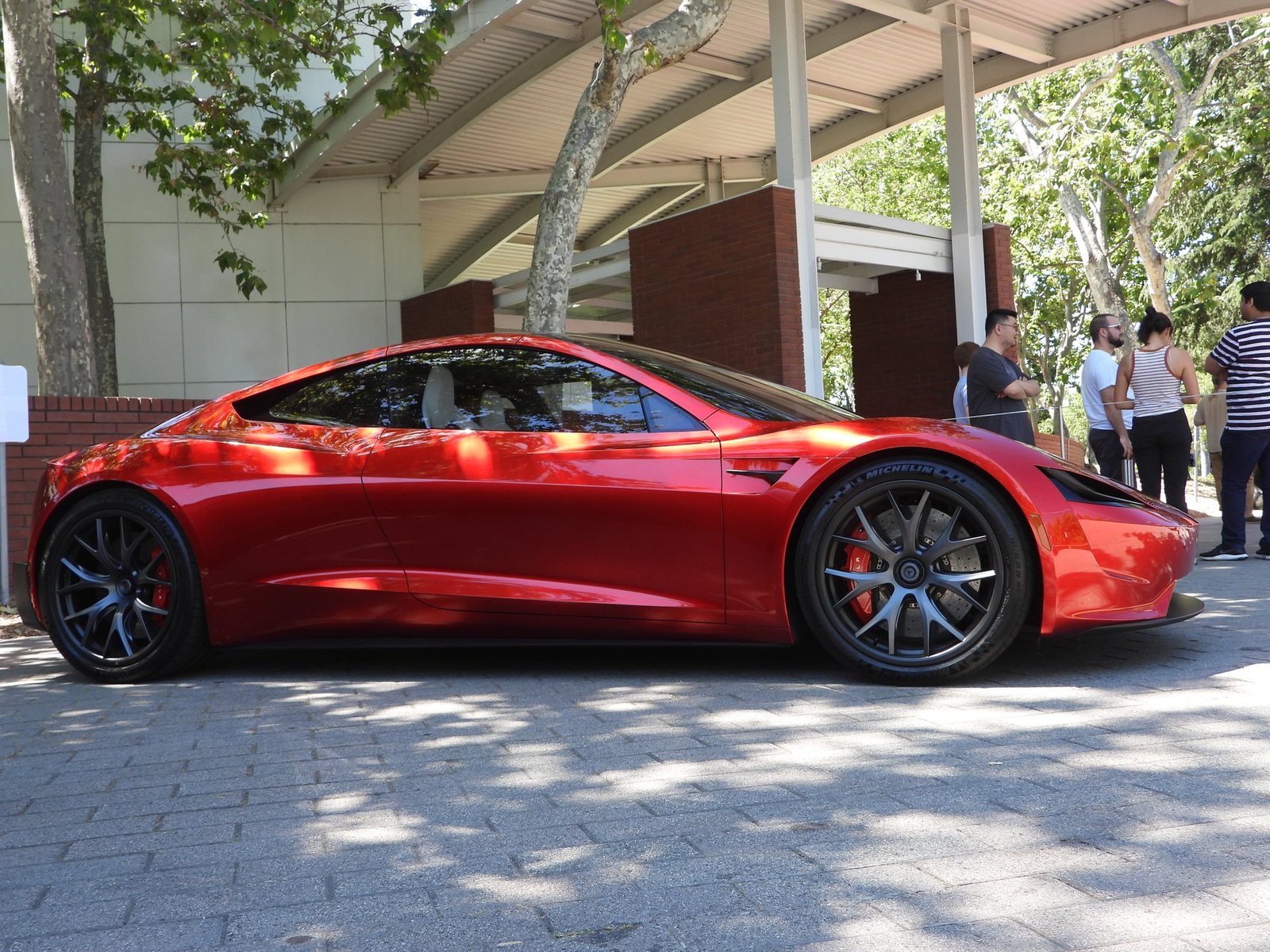

A demo built on fans, compressed air and theater
Tesla vehicle engineering chief Lars Moravy laid out the hardware at the event: ten cold-gas thrusters connected to roughly 600 liters of compressed air, enough to lift and spin the car in midair. On a timed run, the Roadster went from zero to 60 miles per hour in about 0.81 seconds by Tesla’s own clock — the official Roadster page now claims 0-60 mph in under one second with the Thrust augment — and Tesla puts the top speed above 230 miles per hour. No independent outlet has clocked those numbers; they are Tesla’s timing, delivered on Tesla’s staging.
To show the system works in motion rather than on a lift, the car used its thrusters to lift itself over a Cybercab, a Cybertruck, a Tesla Semi, a Model Y and a Model 3 while driving past them. Musk called the machine “better than any James Bond car” and joked that when he first suggested the idea he wondered, “Am I crazy?” He also stressed the demo car was not a one-off: “This will be the actual car that’s on the roads.”
Three trims, and deposits you can already pay
Tesla is building the Roadster in three configurations. The Performance trim seats two and requires a $50,000 reservation — $5,000 upfront plus a $45,000 wire transfer due within 10 days. The Thrust trim, a limited release described as “race ready,” adds a multi-mode suction system plus rear-mounted cold-gas thrusters; reservations there cost $250,000. The Rocket trim is the extreme edge: a single-seat model with a “full flight system” — thrusters positioned around the whole car — that is invite-only and, Tesla says, not approved for public roads and not offered everywhere. Reservations were reopened after the event for buyers in the US, Canada and China.
What Tesla has still not said is the price. Reuters reported expectation of a figure above $250,000, and the deposit only holds a place in line — buyers learn the price when invited to configure. Production is scheduled to start in 2028.
Nine years of “this time it’s real”
The Roadster script is familiar. The second-generation car was revealed as a surprise at the end of the Tesla Semi event in November 2017, and customers placed the same $50,000 deposits then — a thousand of them at $250,000 for a “Founders Series.” In 2018, Musk tweeted that a SpaceX option package would add “~10 small rocket thrusters arranged seamlessly around car” and might “even allow a Tesla to fly.” Then came Model 3 production hell, the Model Y, the Cybertruck, and a delay in 2020, 2021, 2023 and 2024. Late 2025 brought a promise to reveal by December — followed, a week later, by a new target of April 1, 2026 that Musk picked because an April Fools’ date would give him “some deniability” if it slipped again. It did; an October 1 attempt was postponed for severe weather.
What it means for Tesla
Musk himself conceded the halo car is a marketing instrument, saying he is “not sure it moves the needle massively from a revenue standpoint.” Its real function is narrative: proof-of-engineering theater at the moment Tesla’s core business faces intensifying competition. That is also why the safety framing will draw scrutiny. Asked about the car on a podcast earlier this year, Musk said, “Safety is not the number one goal” of the Roadster — adding that Tesla would “aspire not to kill anyone in this car.” Regulators, and the first customers, will treat those as very different promises.
What to watch
- Independent verification of the 0.81-second and 230 mph figures, both currently Tesla’s own numbers.
- Whether the invite-only Rocket trim can win any approval to operate on public roads, or stays a closed-course curiosity.
- A price reveal when configuration invitations go out — the first real signal of who this car is for.
- Whether the 2028 production date sticks, given that every prior Roadster deadline has already been missed.
Sources: Reuters (via US News), TechCrunch, CNBC, gettesla.com configurator record.