
 By asahifile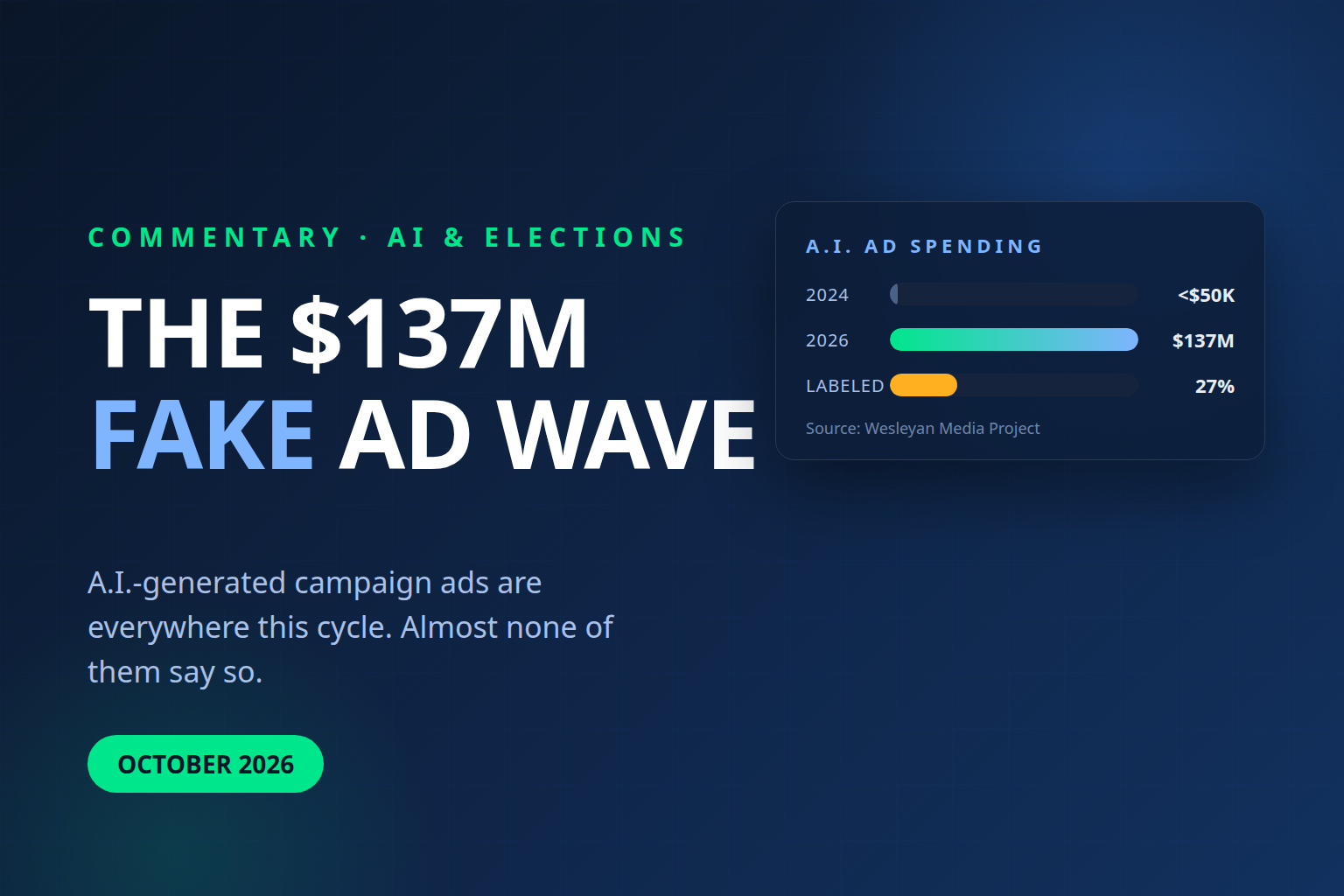
An ad running in New York this fall shows Mayor Zohran Mamdani and Gov. Kathy Hochul strolling through a sun-drenched park, gardening side by side and promoting a fictitious “political delusion pill” to cure voters’ fears about affordability and crime. “Side effects may include: chronic wallet shrinkage, higher tax,” a narrator intones. The faces and voices are real; the scene never happened. It was fabricated with artificial intelligence by the campaign of Bruce Blakeman, the Republican candidate for governor, and carried no disclaimer that A.I. was involved.
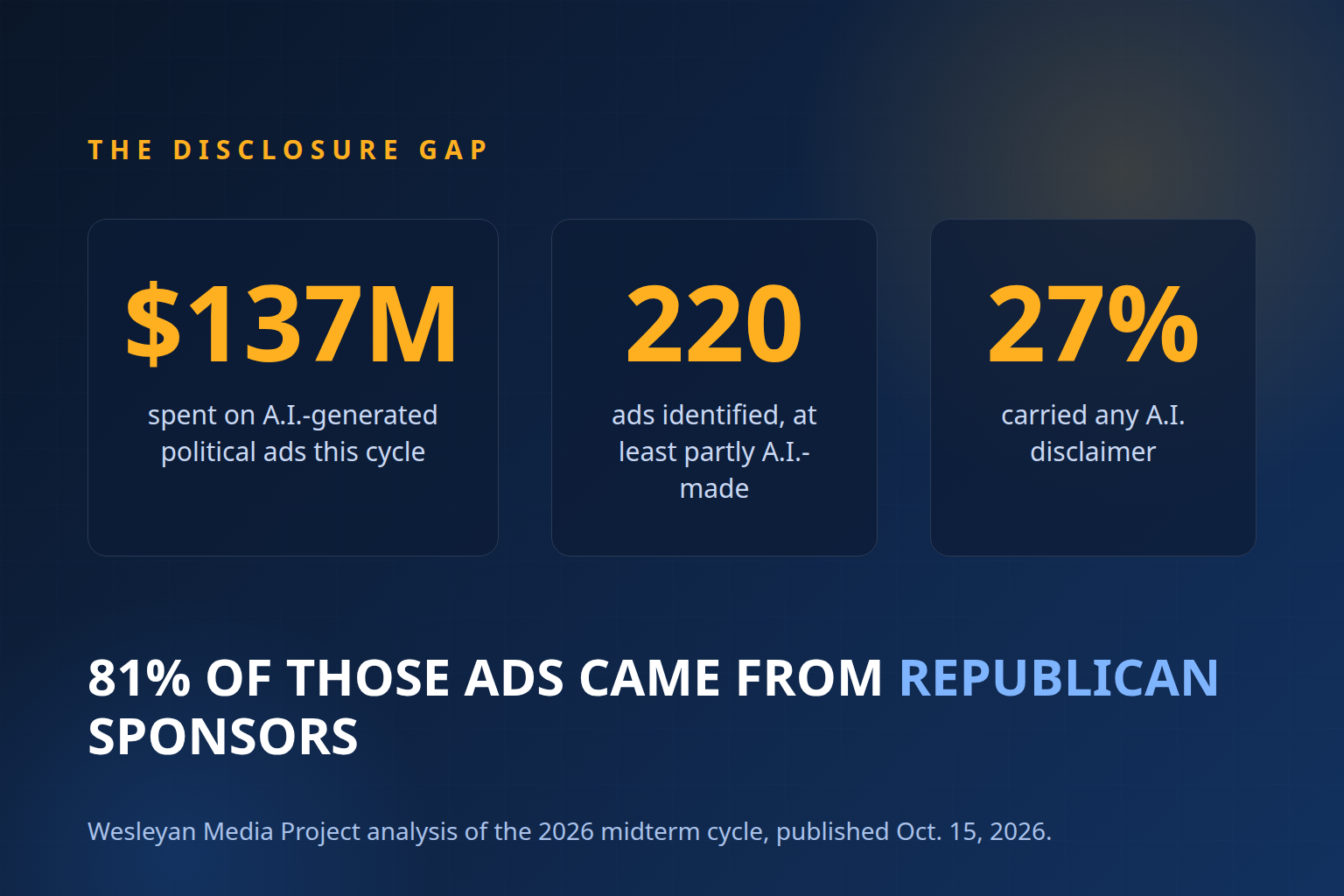
That spot is one of more than 220 ads the Wesleyan Media Project identified this midterm season as using A.I.-generated fakery. Candidates and political groups, mostly tied to Republicans, have spent more than $137 million promoting such ads this year, the researchers found, up from less than $50,000 in the 2024 cycle. “I think what we’re seeing with A.I. has surprised even us,” Erika Franklin Fowler, a Wesleyan professor and co-director of the project, told The New York Times.
A market that went from near zero to $137 million
A technology that barely registered in political advertising two years ago now underwrites a nine-figure market: 220 identified ads across 34 states, 81 percent of them sponsored by Republican candidates or Republican-aligned groups and 12 percent by Democrats, with Republican-affiliated sponsors accounting for 88 percent of the spending. The researchers call their count a floor, not a ceiling, because AI use is often undetectable and frequently undisclosed. An American Association of Political Consultants survey found 83 percent of political professionals now use AI tools weekly, up from 59 percent a year earlier.
“Is it A.I.?” is the wrong question
Framing this as a labeling problem risks missing the enforcement question underneath. A fabricated scene of two public officials promoting a fake medication is potentially actionable as deception or defamation whether a model or a human composited it. The tool is not the harm; the falsehood is. That distinction determines who has jurisdiction, what the remedy is, and whether it survives a First Amendment challenge.
Voters appear to draw the same line. An AAPC Foundation survey found 95 percent of likely 2026 voters consider it unacceptable for a campaign to use AI to make a video of an opponent saying something they never said, and 84 percent object to AI voice clones of a candidate’s own voice. “Don’t use AI to deceive me or dupe me,” said Julie Sweet, the AAPC’s director of advocacy and industry relations.
The cost curve, not the craft
Generative tools collapse the marginal cost of a persuasive ad to nearly nothing. A campaign that once commissioned one spot can now generate hundreds of variations, re-cut for each platform. When production is nearly free, the rational strategy shifts from quality to volume: saturate inventory, test messages at scale, accept that most versions will fail. The $137 million figure measures less AI’s persuasive power than how cheaply a message can now be manufactured and abandoned.
What to watch
- Whether Congress or the FEC revisits a dedicated federal AI-advertising rule, and whether it would pre-empt or preserve the state statutes now in force.
- How the roughly 30 state disclosure regimes are enforced — the first actions will reveal whether the laws bite or merely exist.
- Whether litigation over California’s deepfake framework produces a standard other states copy, or one that narrows what they can require.
- Whether post-election surveys register the distrust the AAPC poll found.
Sources: The New York Times, Campaigns & Elections, Campaigns & Elections (transparency baseline), Associated Press, Election Law Blog