
 By asahifile
Deforestation in the Brazilian Amazon has fallen to the lowest level in the satellite record. On Friday, Brazil’s National Institute for Space Research (INPE) released its PRODES annual estimate showing that 3,335 square kilometres of rainforest — roughly 1,288 square miles — were cleared in the twelve months ending July 31, 2026, a decrease of 41.8 percent from the previous year’s figure of 5,731 square kilometres. INPE has measured annual clearance by satellite since 1988, and the new number is the smallest it has ever recorded, beating the previous record low by 1,236 square kilometres.
For scale: the area saved against that earlier record is about the size of the city of Rio de Janeiro, and the total year’s clearance is smaller than the Spanish island of Mallorca. But the timing gives the statistics an edge of drama that the raw figures do not. The release lands nine days before Brazil’s presidential run-off on October 25, in which incumbent Luiz Inácio Lula da Silva faces Senator Flávio Bolsonaro, son of former president Jair Bolsonaro. Polling has put the two nearly tied, which turns a four-decade environmental record into a live campaign argument.

The numbers behind the record
The headline percentage conceals a distribution. Pará registered the largest share of the year’s Amazon clearance at 33.9 percent, followed by Mato Grosso at 25.5 percent and Amazonas at 15.7 percent — yet even in those three states, clearing fell by more than 45 percent year over year. Roraima, a Bolsonaro-family stronghold in the country’s far north, was the only Amazon state where deforestation rose, and barely: up 0.4 percent, according to the Guardian’s analysis of the series.
The neighbouring Cerrado, the tropical savanna that has long served as a pressure valve for agricultural expansion, also posted its lowest annual loss in the series: 5,516 square kilometres, down 24 percent and a 48.4 percent reduction over four years. Since 2022, the year before Lula took office, the Amazon rate has fallen 71.2 percent in total — an acceleration environment minister João Paulo Capobianco described as “an absolutely stratospheric drop… it’s like a dream.”
What policies the credit traces back to
The reduction windows correspond to a specific set of measures: restored law-enforcement operations in the forest, reopened environmental-agency budgets, resumed demarcation of Indigenous territories and protected areas, and a revived satellite-monitoring apparatus that flags clearing in near real time. President Lula, announcing the figures, restated the country’s standing target of zero illegal deforestation by 2030. Climate policy group Observatório do Clima called the data a “historic achievement” and credited sustained monitoring plus stiffer penalties for illegal logging.
Any reading of the record should note what it is measured against. During Jair Bolsonaro’s 2019–2023 term, Amazon deforestation rose 59.5 percent amid budget cuts to protection agencies and weakened enforcement, so part of the improvement is a return to a prior trajectory rather than an entirely new one. The competing candidates’ platforms diverge sharply on this record: Flávio Bolsonaro has campaigned on easing protections and opening the Amazon to more extractive development, while Lula’s platform runs on extending the current enforcement model. Seven of the nine governors of Amazon states are aligned with the Bolsonaro campaign, a fact that complicates any federal policy continuity regardless of who wins.
What a close poll means for the data
Conservation groups have been explicit that the achievement is politically contingent. “The country will decide whether we move toward the end of deforestation or toward the end of the forest,” Observatório do Clima’s executive secretary Marcio Astrini said in a statement reported by the Guardian. Former environment minister Marina Silva has publicly warned that a Bolsonaro administration would attempt to undo the enforcement architecture. How much deforestation can actually rebound in a single administrative cycle is an open research question, but the 2019–2023 spike offers one natural experiment, and investors in Brazil’s agribusiness exporters are watching closely.
The forest itself does not wait on the vote
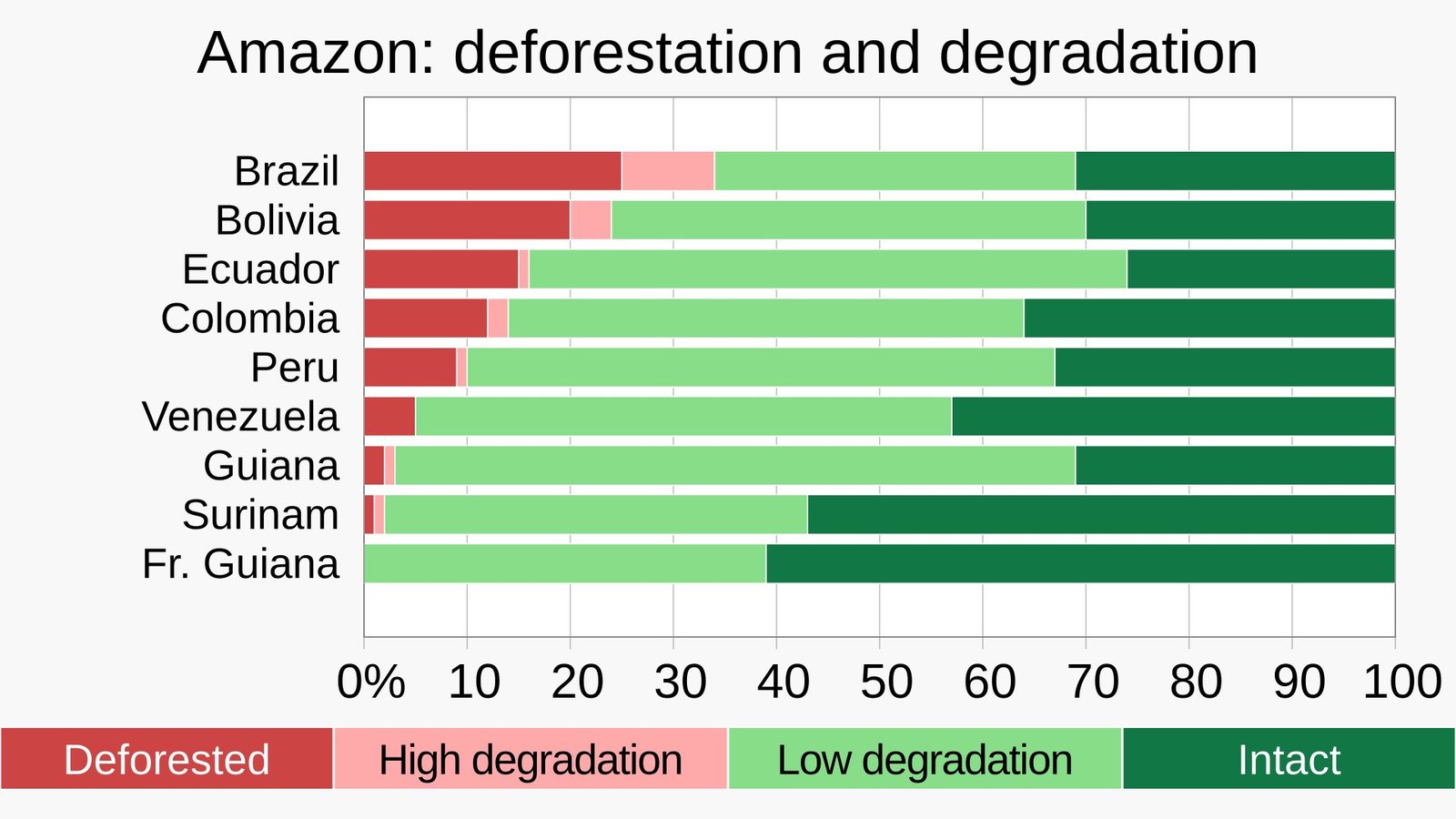
About 15 percent of the Amazon biome has now been deforested, according to analysis by the nonprofit Amazon Conservation. Research cited by Mongabay places the theoretical tipping point — where the forest’s own evapotranspiration-driven rainfall system begins to fail — at 20 to 25 percent of the biome. Meanwhile a strong El Niño pattern is developing in the Pacific, historically associated with drought and fire seasons in the southern Amazon; fire damage typically peaks in the year after such an event. The next satellite release will cover exactly that window.
- The October 25 run-off result, and which environmental-enforcement budgets survive a transition.
- Real-time deforestation alerts (DETER) during the El Niño drought and 2027 fire season.
- Whether the Cerrado’s trajectory can hold up its end — it protects little of the Amazon’s rainfall engine, but carries much of its soya and beef expansion.
Sources: Mongabay; DW; The Guardian (via Yahoo); INPE PRODES satellite series.