
 By asahifile
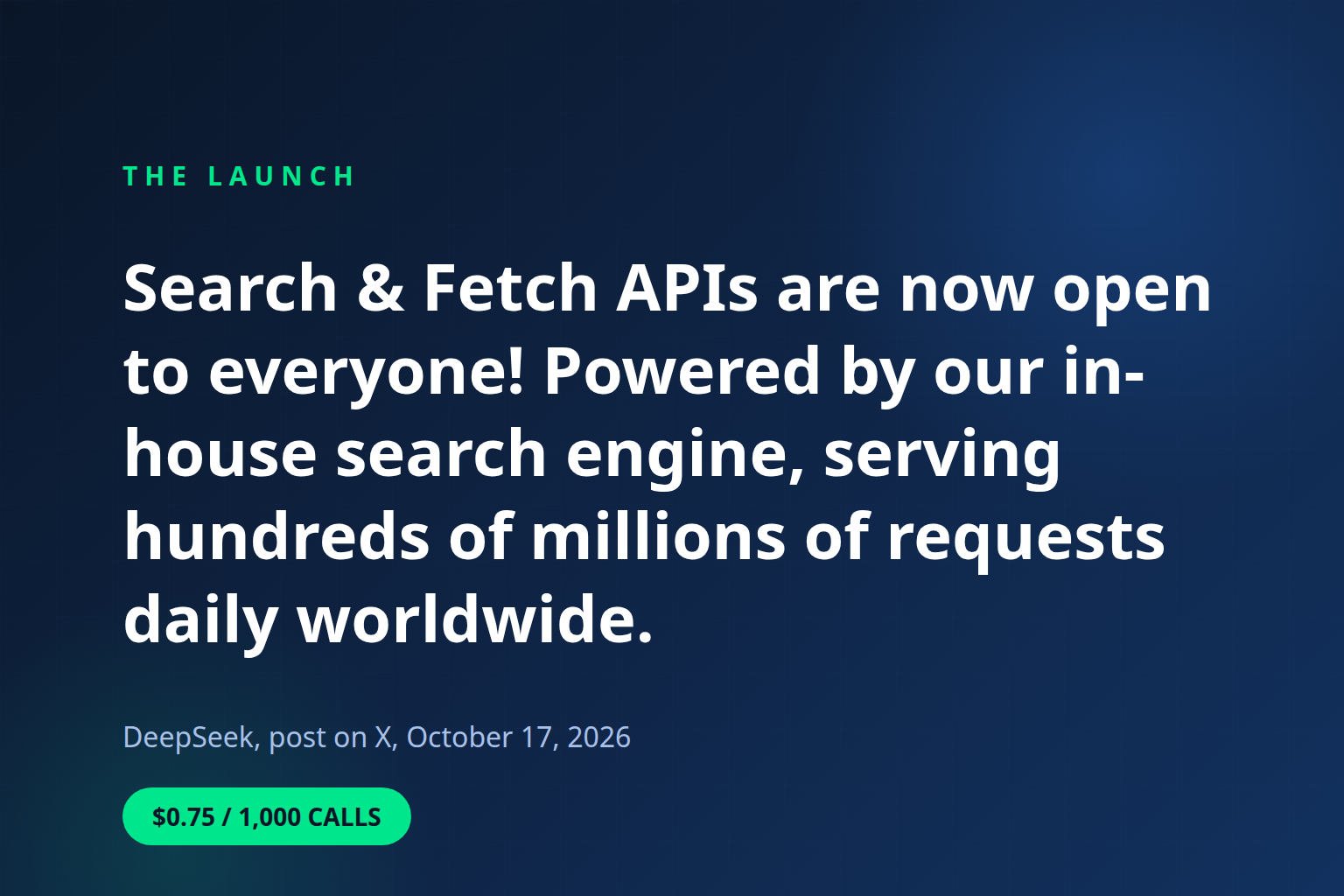
DeepSeek opened its Search and Fetch APIs to all developers on October 17, 2026, announcing the move in the third post of a four-part thread on X. “Search & Fetch APIs are now open to everyone!” the company wrote, adding that the endpoints are “powered by our in-house search engine, serving hundreds of millions of requests daily worldwide.” Until then the retrieval tools had been available to a narrower group of users.
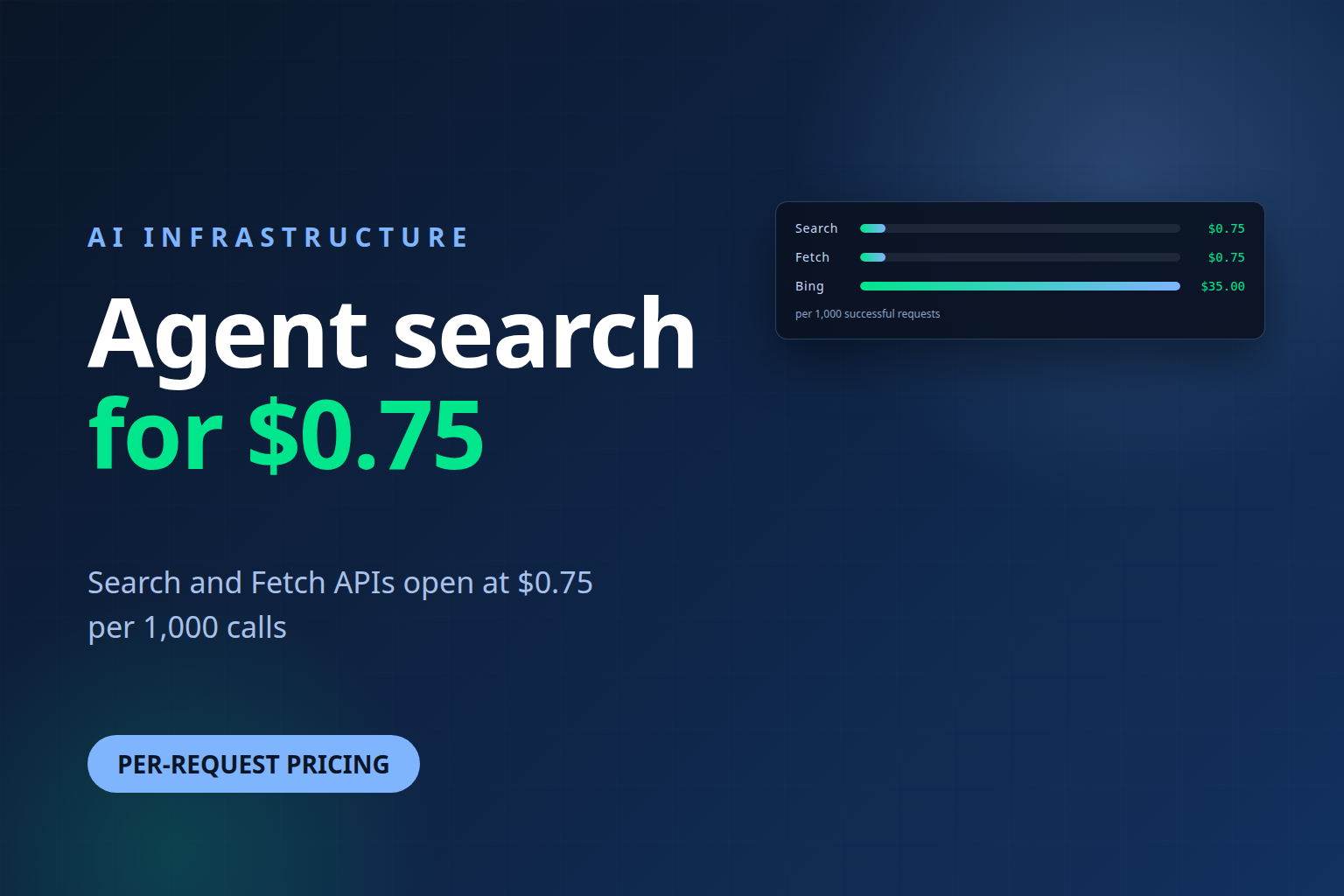
The pricing is the story. DeepSeek charges $0.75 per 1,000 successful requests for each endpoint, billed per request rather than per token and not per returned result — asking for fifty results costs the same as asking for one. Only calls that return HTTP 200 and produce a result are billed; failed requests, empty search results and timeouts are not. The documentation sits at api-docs.deepseek.com/guides/search, with endpoints at api.deepseek.com/v1/tools/search and api.deepseek.com/v1/tools/fetch.
What the two endpoints actually return
Search returns up to fifty ranked results, each with a score, an authority tier, a short snippet of roughly 100 to 200 characters and a longer model-oriented summary of about 600 to 800 characters. Fetch takes a single page and converts it to Markdown, the format most language models handle most cheaply. Together they cover the retrieval loop agent frameworks need: find candidate pages, then read them.
Rate limits, and a free window that closes on October 31
Both endpoints are capped at five requests per second per account, applied at account level regardless of how many API keys are issued, with Search and Fetch limited independently — roughly 432,000 calls a day per account by ppc.land’s calculation. Fetch also carries an undisclosed per-domain limit. For now, server-side tool calls through DeepSeek Harness, Claude Code and Codex are free for DeepSeek API users; billing starts at 16:00 UTC on October 31, which is midnight Beijing time on November 1.
The launch arrived alongside DeepSeek-V4.1-Flash-1017, released the same day under an MIT licence with open weights. It replaces V4.1-Flash across the site, app and API with the calling method and pricing unchanged, and DeepSeek claims a score of 77.0 on the DeepSWE v1.1 benchmark against Claude Opus 5 at 74.0 — a vendor figure that has not been independently verified. Model pricing is $0.30 per million uncached input tokens and $1.20 per million output tokens at peak, halved off-peak, with peak hours defined as 01:00-04:00 and 06:00-10:00 UTC on weekdays.
Why the comparison is more than a price list
The obvious comparison is with incumbent search APIs. A single-outlet snapshot puts Brave Search at $5 per 1,000 calls, Exa at $7 standard and $12 for deep search, Tavily at $5 to $8, and Perplexity’s Sonar from $5 plus token costs. Microsoft retired the Bing Search APIs on August 11, 2025 and now pushes “Grounding with Bing” at $35 per 1,000 calls. On those numbers DeepSeek’s $0.75 is roughly one forty-seventh of Microsoft’s rate; Yahoo Finance described it as 6.7 times cheaper than the next cheapest provider and 9.3 times cheaper than Exa’s standard tier. The products are not identical, so the multiples are a rough guide rather than a like-for-like benchmark.
The more telling signal is that an unrelated company landed on the same number in the same fortnight. Cloudflare launched a Web Search API on October 2 that resells partners from $0.25 per 1,000 calls through Ceramic.ai up to $5 for Linkup and $7 for Exa, and its AI Search product starts billing on November 1 with semantic queries priced at $0.75 per 1,000. When two companies with no relationship to each other converge on a price within days, that usually signals a market clearing rather than a promotion. Retrieval is turning into a metered utility, priced per lookup, sitting underneath every agent that browses.
Caveats worth keeping in view
A launch price is not a permanent price; DeepSeek raised prices on another product earlier this year. The “hundreds of millions” figure appears in the X post but not in DeepSeek’s own documentation. And the account-level rate limit, plus the per-domain Fetch cap, constrains how large a crawl any single customer can run.

What to watch
- Whether the $0.75 rate survives past the free window and a first quarter of real usage.
- Whether Cloudflare’s November 1 billing start holds at the same price point, or the two vendors diverge.
- How RAG pipelines and agent startups reprice their own products once retrieval is a line item rather than a free call.
- Whether any incumbent search API vendor cuts list prices in response, or bundles retrieval into existing cloud spend.
Sources: ppc.land, DeepSeek API docs, Yahoo Finance